Caring Founder: Coming Back to Where It All Began
Six years ago, I went to Rathlin Island with my family.
Sailing was one of those hobbies that worked for everyone in our house. We never managed to pack light - nappies, a double buggy for the twins, entertainment for Georgia and her sister and everything else that travelled with a family of six to be prepared for all weather. But once we got there, life was simple. Pier jumping, rowing, crab fishing.
Time slows down when you step on the boat.
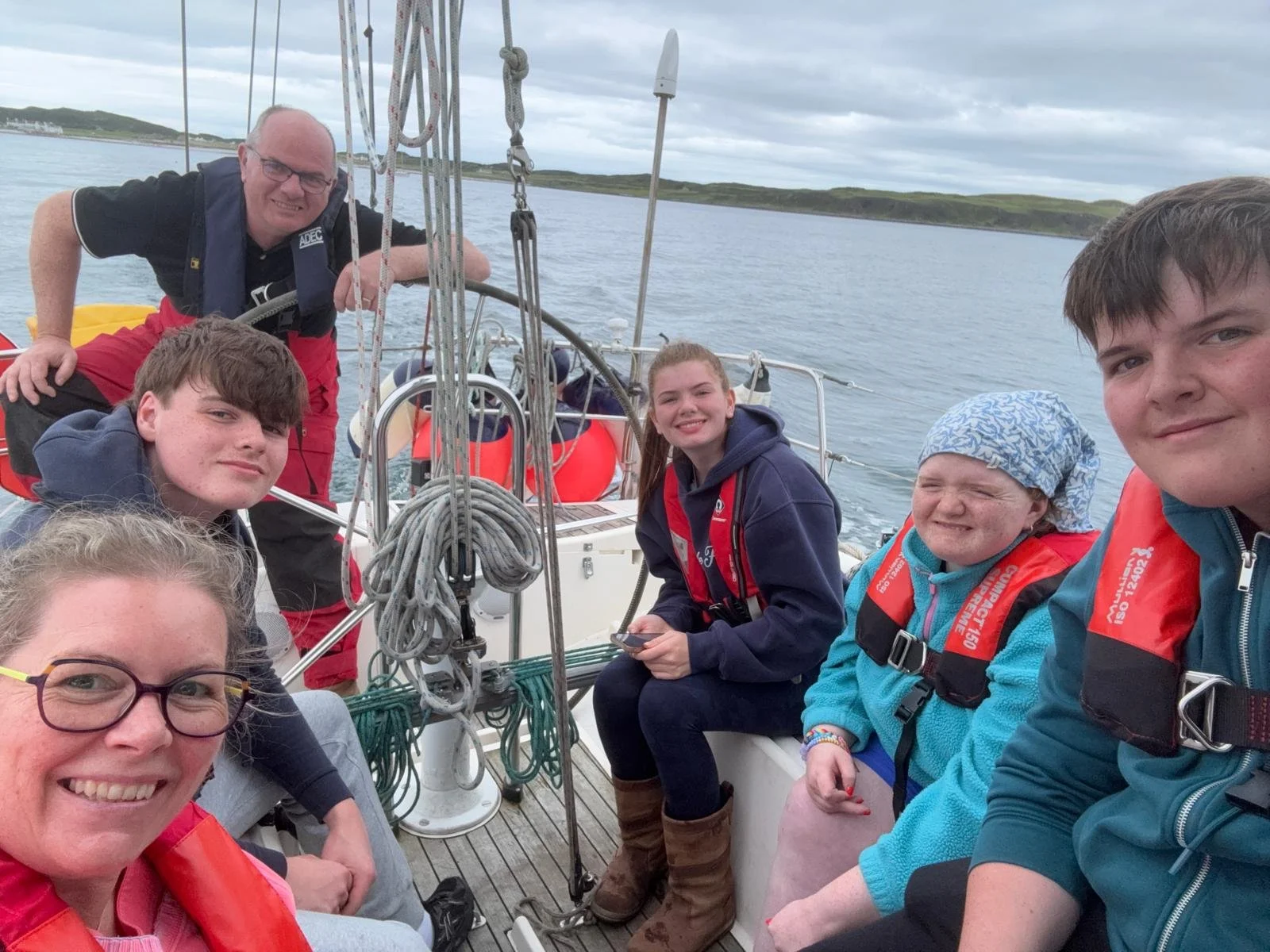
This month we went back to Rathlin.
George sailed over with the teenagers on Thursday evening and Georgia and I joined them as foot passengers on Friday. Between poor health and other commitments, Georgia and me hadn't been aboard Dream Machine for a few years. To be honest, I'd wondered if I would ever get back on the boat. It had started to feel like such a big task.
But we did it. We stayed aboard and motored home together.
It felt like an achievement in itself.
We were back on Rathlin. Our children's favourite holiday destination and the place where my inCharge journey began.
Six years ago, I wasn't a tech founder. I had a good, secure job. Four children. Caring responsibilities. And, from watching the reality of my husband's business, a fairly good idea of what self-employment could take out of you.
I really didn't need to make my life any more complicated.
But I could see an unmet need.
I didn't completely understand the problem yet. I certainly didn't have the solution. But I had a strong sense that something wasn't working and there had to be a better way.
If I wasn't the person to solve it, that was fine. But at least I would explore it and learn something along the way.
Six years later, that feels like the first of three big lessons I have learned as a caring founder.
Lesson 1: You don't have to understand the whole problem before you start
My original thinking was actually about managing a Personal Budget. How could we track the money safely? How could we make sure it was properly governed? Could technology make that easier?
Turns out banks are really good at managing money!
The more research I did, and the more families and people I spoke to, the more I realised that the problem was somewhere else.
It was in all the information that sits around one person.
Their routines. Preferences. Communication. Support. The things that matter to them. The seemingly small things that can turn a good day sour or bring enormous joy. And how fragmented all of that can become when several people are involved in someone's life.
So the idea changed. I suppose technically we pivoted. It never really felt like that to me. It felt like a gradual growth in understanding. That still happens today.
Lived experience gave me a starting point and a strong instinct that something wasn't working. It didn't automatically give me the answer.
Listening, researching, co-designing, testing, failing, fixing and going again helped us find that. And we're still learning.
Lesson 2: You don't have to know everything yourself
There's a slight problem when you decide to build a technology company and you're not actually a technologist. You have to learn. A lot. Every. Single. Day!
Weirdly, I wasn't particularly afraid of the technology. I was much more afraid that I wasn't the right person to build it. That took longer to get over.
I've learned enough technical language over the years to hold my own in the conversations that count. But I've also learned that my job isn't to be the best technologist in the room. My job is to understand the problem, protect the vision, ask the right questions and listen to the people using what we build. And then be with people who are much better than me at the things I can't do. That sounds cliche but it's true and it can be a very lonely place until you find them.
Finding that team has probably been one of the most important parts of the whole journey.
My dream team didn't just understand technology. They understood the purpose behind it. They let me explain problems in non-technical language, using real people, real families and real-life examples. They understood that whatever we built couldn't just look good on a screen.
It had to work in real life.
For the person. For the family trying to lighten the load. For the PA trying to do their job well.
And now for providers trying to put personalised care into practice across their services.
Six years ago, I couldn't have explained how we would build that technology. Today, we have technology being used by families and providers to do exactly that.
Lesson 3: Progress rarely feels like progress when you're in the middle of it
This might be the biggest one.
There have been plenty of times over the past six years when inCharge felt painfully slow.
Times when I've wondered whether I had the stamina, finance, backing, luck or ability to make it work.
Times when I've wanted to give up. Times when I've actually tried to give up.
And then you come back to where it all started.
This time I came back to Rathlin with a technology company, a product being used in real life, providers using it to support personalised care, and a team around me who are completely invested in where we're going next.
The technology has become more sophisticated. The ambition has grown. But the principle hasn't really changed.
Start with the person.
Their life. Their choices. Their voice. Their goals.
Then work out how technology can help the people around them support that good life. Not the other way around.
It was a very grounding experience being back on Rathlin. I'd wondered whether Georgia and I would manage the trip with our new mobility. We did.
I'd once wondered whether I was capable of building a technology company. Apparently, I'm doing that too.
Neither journey has been particularly straightforward. And maybe that's the point. Progress doesn't always look or feel like progress when you're living through it. Sometimes you need to go back to where you started to see just how far you've travelled.
And then get back to work on where you're going next.
If coordinating care is part of your everyday life, inCharge was built with you in mind. Start your free 30 day trial - you won't be charged until day 31. Find out more, click here.
If you work with families who coordinate their own care and support, we'd love to talk. Get in touch to find out more about partnerships and pricing, click here.